Channel Islands National Marine Sanctuary

Published

April 16, 2026

Ocean Sound Monitoring

The Channel Islands National Marine Sanctuary (CINMS) surrounds the five northern Channel Islands and is situated across the Santa Barbara Channel. Within the Channel, two powerful currents, the northbound Davidson Current and the southbound California Current, meet and respective warm and cool waters mix. That mixing combined with seasonal high winds make this region extremely productive. This productivity makes CINMS a global foraging hotspot for marine life, like whales and fish. The CINMS region consistently has some of the highest reports of commercial fishing value and volume. At the same time, this region is also home to consistent commercial ship traffic transiting through established Traffic Separation Schemes, acting as major highways for large vessels. Much of the region is also inside a Naval Testing and Training area, and Vandenberg SpaceForce Base has signifantly increased launch activites that go over CINMS since 2024.

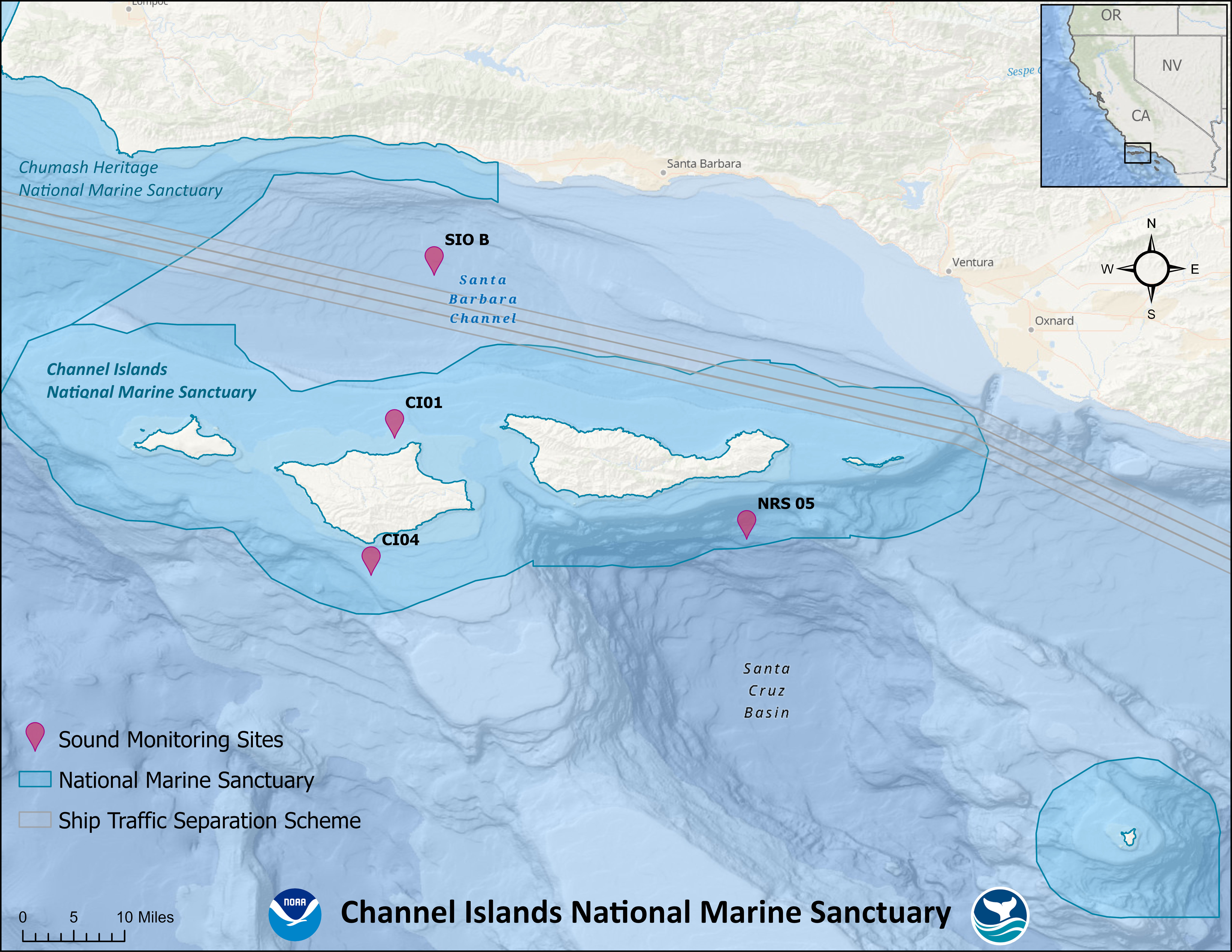
The bustling activity of both biological and human activity in this region has been monitored using passive acoustics for decades. A Noise Reference Station has been in place on the backside of Santa Cruz Island since 2014. Scripps Instituion of Oceanography has been monitoring underwater sound across the Southern California Bight at many locations for many years, including at Site B inside the Santa Barbara Channel—a listening station that provides Vessel Speed Reduction noise measureuments to the shipping industry each year during voluntary slowing periods. CINMS began monitoring sanctuary soundscapes in 2018, with the establishment of CI-01 and CI-04 located to the north and south of Santa Rosa Island, respectively. Woods Hole Oceanographic Institution maintains a near real-time buoy that provides large baleen whale detections at whalesafe.com.

To see historical CINMS monitoring sites that are no longer active, please visit Sanctuary Soundscape Project data portal.
Summary of monitoring sites

Long-term Monitoring Site Primary Monitoring Purpose Oceanographic Setting Depth (m) Sampling Rate (kHz) Known Biological Sounds Vessel Traffic Setting Latitude Longitude StartDate Total Recording Days
CI01 This shallow reef within a no-take marine reserve supports vibrant fish communities and is exposed to noise inputs (seal bombs) from nearby fishing. coastal-shallow, adjacent to kelp forest ecosystems 20 48 Fish and baleen whales Adjacent to the Traffic Separation Schem in the Santa Barbara Channel, and near popular fishing and ocean recreation sites 34.04 -120.08 Jan 2022 516
CI04 Inside a no-take marine reserve and adjacent to voluntary shipping lanes. This area on the south side of Santa Rosa Island is exposed to weather and military activity. coastal-shallow, on Santa Rosa Flats (sand flat) 156 48 Fish, baleen whales, dolphin, and orca Near fishing areas, recreation areas, and military activity 33.85 -120.11 July 2022 426
SIOB Situated in the Traffic Separation Scheme, this high frequency acoustic recording package (HARP) captures all sound associated with the vessel traffic coming in and out of the Ports of Los Angeles, Long Beach, and Hueneme to the northwest. This site is just outside the northern boundary of the sanctuary, in prime baleen whale foraging habitat. coastal-deep, in the Santa Barbara Channel shipping lanes 580 200 Fish, baleen whales, dolphin, and orca Constant large vessel activity from ships in shipping lane in Santa Barbara Channel 34.28 -120.02 Mar 2024 392
NRS05 This site sits at the top rim of the Santa Cruz Canyon in the deep sound channel, which captures whale, vessel, and military activity from great distances. coastal-deep, on the slope of Santa Cruz Canyon on the CINMS soutern boundary 900 5 baleen whales Large vessel activity, including miliary, transiting south of CINMS 33.9 −119.58 Oct 2014 3903

Ocean Sound Conditions

Soundscapes vary across years, seasons, and even within a day. Differences are driven by shifts in wind and weather patterns, migration and behavior of animals, and patterns in human activities. We track how sound levels change in different frequencies using standardized soundscape metrics to understand these changes. Seasonal and annual percentiles of all the data, a measurement of data spread with the middle 50% falling between the 25th and 75th percentile, are used to define typical conditions.

What are the seasonal patterns across frequencies?

Season is often a main driver of soundscape differences: wind and weather patterns shift, species migrate or change behavior, and humans change their marine activities. As shown on the graphic(s) below, we can visualize the differences by looking at the variation across frequency (pitch of the sound in Hertz) shown on the x-axis and intensity (how loud the sound is in decibels) shown on the y-axis. The colored lines represent regionally-specific oceanographic seasons, vertical shaded bars are the frequency ranges that a sound source of interest can be heard, and the black lines bound the expected range of modeled sound intensity when only wind noise is present.
Here are some questions to consider when viewing the graph(s) below:
(1) Which season has the highest sound levels?
(2) Are there peaks in the sound levels for any of the sounds of interest?
(3) Are the low-frequency sound levels outside the expected range for wind noise?

Line graph of seasonal median sound levels (sound intensity measured by mean-square pressure in microPascal per Hertz) across a range of frequencies (~10 to ~24,000 hertz) for all data at a given monitoring site, with annual recording effort represented by a bar graph underneath. Each season is a different colored line. Modeled ambient sound levels from wind are shown as solid black lines. Frequency bands indicative of a sound source of interest are highlighted in semi-transparent gray and labeled; peak frequencies of interest for some fish species are labeled with vertical dashed lines and labeled by species.
Seasonal median sound levels (sound intensity measured by mean-square pressure in microPascal per Hertz) across a range of frequencies (~10 to ~24,000 hertz) at a given monitoring site, with annual recording effort represented by a bar graph underneath. Each season is a different colored line. Solid black lines show modeled ambient sound levels from wind at 1 m/s (lower line) and 22.6 m/s (upper line) based on hydrophone depth. Frequency bands indicative of a biological or anthropogenic sound source of interest are highlighted in semi-transparent gray and labeled; peak frequency for dominant fish species are labeled with vertical dashed lines. Credit: Megan McKenna and Emma Beretta/CIRES and NOAA

Processing raw audio files to calibrated sound levels (i.e., soundscape metrics) involves multiple steps to get a specified time frequency data product. All soundscape metrics visualized in the soundscape inventory reports are averaged from hybrid millidecade sound levels, calculated using either MANTA or PyPAM software packages. Both softwares calculate mean PSD (dB re 1 µPa^2/Hz) per minute in 1-Hz wide bins using Welch’s method with a Hann window, FFT length equal to the sample rate, and 50% overlap. Following calibration based upon instrument specific sensitivities, PSD values per minute were further processed in hybrid millidecade spectral densities, which are an efficient means of storing PSD spectra from high sample rate audio files using 1-Hz values up to 435 Hz, and then millidecade wide PSD values up to one half of the sample rate (Martin et al. 2021).

PAMscapes was used to calculate hourly median hybrid milli-decade bands (loadSoundscapeData(ncFile, keepQuals = c(1,2)) and binSoundscapeData(hmddata, bin = "1hour", method = c("median")). The hourly data were then matched with an estimate of wind speed at that location using matchGFS in PAMscapes (Global Forecast System (GFS) weather model). Long-term condition plots in these reports were generated by averaging the hourly median hybrid millidecade results within different time constraints (i.e. annual, seasonal) and percentiles (e.g., 25% and 75%) for each hybrid millidecade frequency band.

How are ocean sound conditions changing across years?

We can track changes in ocean soundscape conditions and its contributors by comparing annual sound levels. Efforts to reduce noise impacts to marine animals are underway on local to global scales. Strategies can include avoidance of times and areas when sensitive species are present to reduce vulnerability (e.g., a shipping lane), changing the operation of a potentially hazardous noise source (e.g., by slowing and therefore quieting vessels) or through the design and use of alternative, quieter sources (e.g., new, quieter ship design and/or technologies). The effectiveness of these approaches, and the scales over which they are effective, can be tracked through comprehensive monitoring efforts. A focused analysis is often necessary to tease apart the multiple drivers of ocean sound levels, however, annual summaries provide initial insights to overall patterns.
Here are some questions to consider when viewing the graph(s) below:
(1) Are levels lower in the most recent year of monitoring in any of the frequencies of interest?
(2) Are there peaks in the sound levels for any of the sounds of interest? Do they differ across years?

Line graph of annual median sound levels (sound intensity measured by mean-square pressure in microPascal per Hertz) across a range of frequencies (~10 to ~24,000 hertz) for all data at a given monitoring site, with annual recording effort represented by a bar graph underneath. Each year is a different blue line, getting darker for every additional year of data. Modeled ambient sound levels from wind are shown as solid black lines. Frequency bands indicative of a sound source of interest are highlighted in semi-transparent gray and labeled; peak frequencies of interest for some fish species are labeled with vertical dashed lines and labeled by species.
Annual median sound levels (sound intensity measured by mean-square pressure in microPascal per Hertz) across a range of frequencies (~10 to ~24,000 hertz) at a given monitoring site, with annual recording effort represented by a bar graph underneath. Each year is a different blue line, getting darker for every additional year of data. Solid black lines show modeled ambient sound levels from wind at 1 m/s (lower line) and 22.6 m/s (upper line) based on hydrophone depth. Frequency bands indicative of a biological or anthropogenic sound source of interest are highlighted in semi-transparent gray and labeled; peak frequency for dominant fish species are labeled with vertical dashed lines. Credit: Megan McKenna and Emma Beretta/CIRES and NOAA

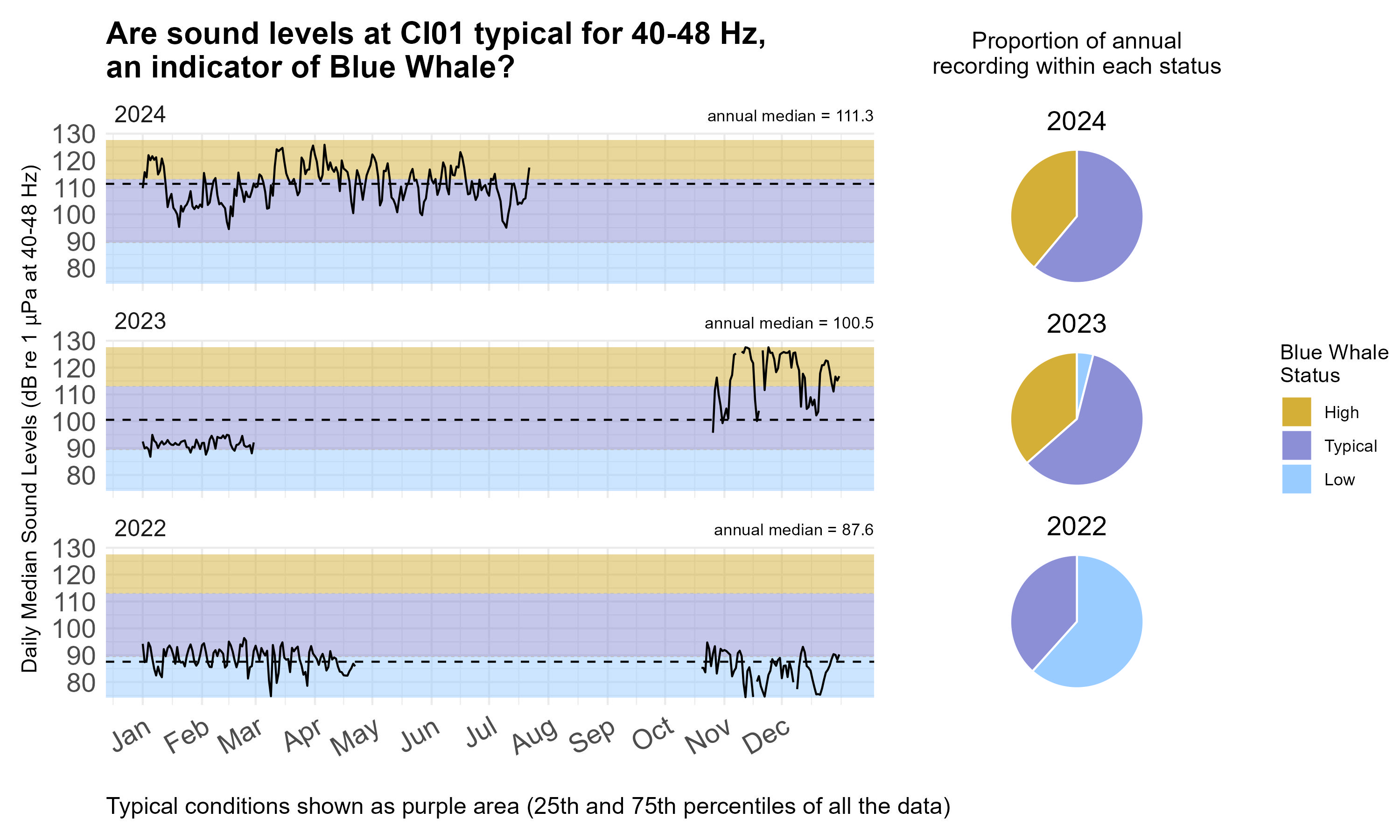
Is the intensity (loudness) of sound sources of interest within typical range?

In some soundscapes, we can use specific frequencies as indicators for the presence of a source of interest (e.g. species presence and behavior). Monitoring sites are often chosen because a known source that we want to track is present and we can track this dominant sound energy contributor using their specific frequency or frequency range. For example, seasonal migration of humpback whales to Hawaiian Islands results in soundscapes dominated by their calling between 50 and 630 Hz. At sites near commercial shipping lanes, 63 and 125 Hz one-third octave level (TOL) are used as an indicator for ship noise (Haver et al. 2021)). At sites where snapping shrimp are present, 4,000 - 18,000 Hz can be used as an indicator of their sounds. Only frequencies that have been identified as reliable for tracking a source of interest are shown below.

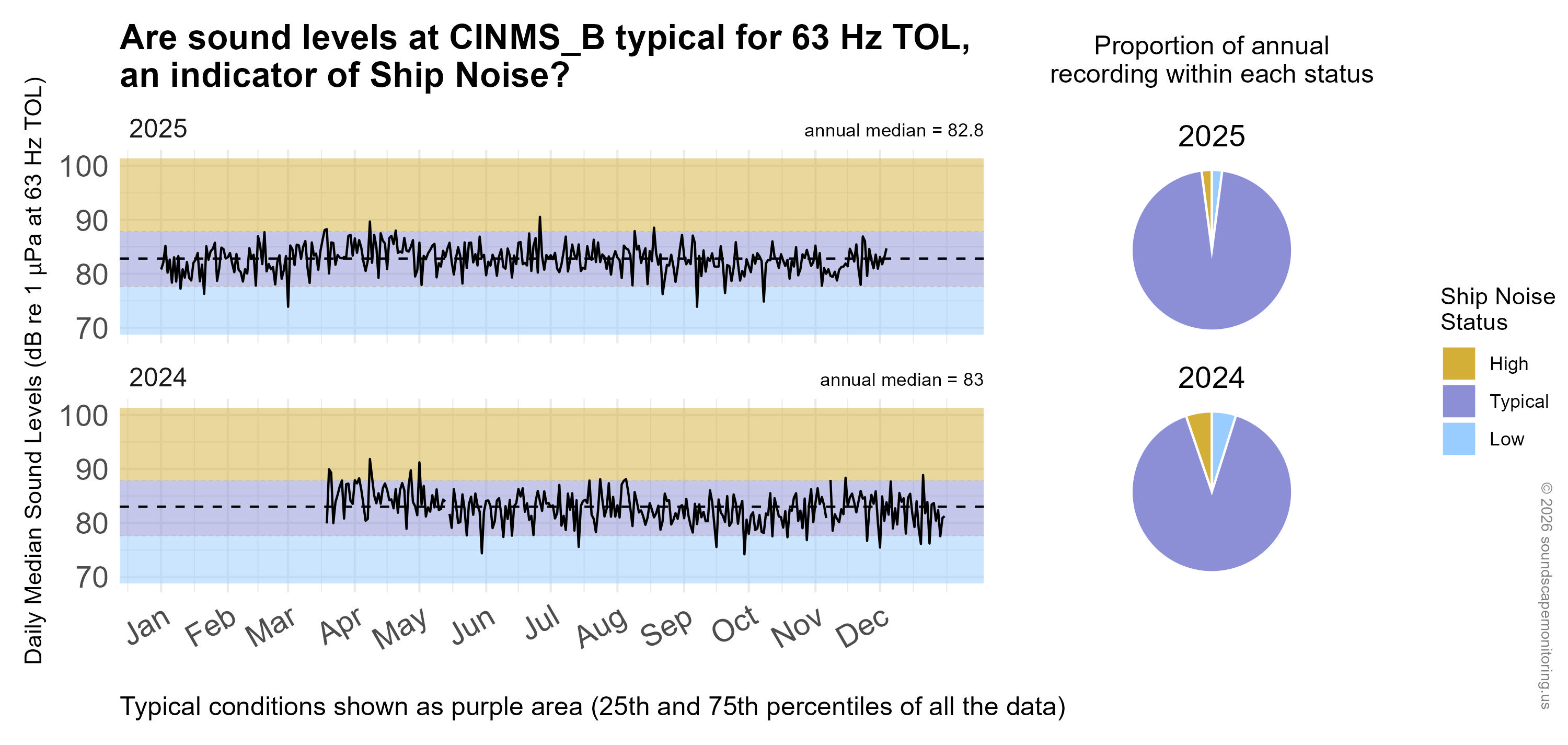
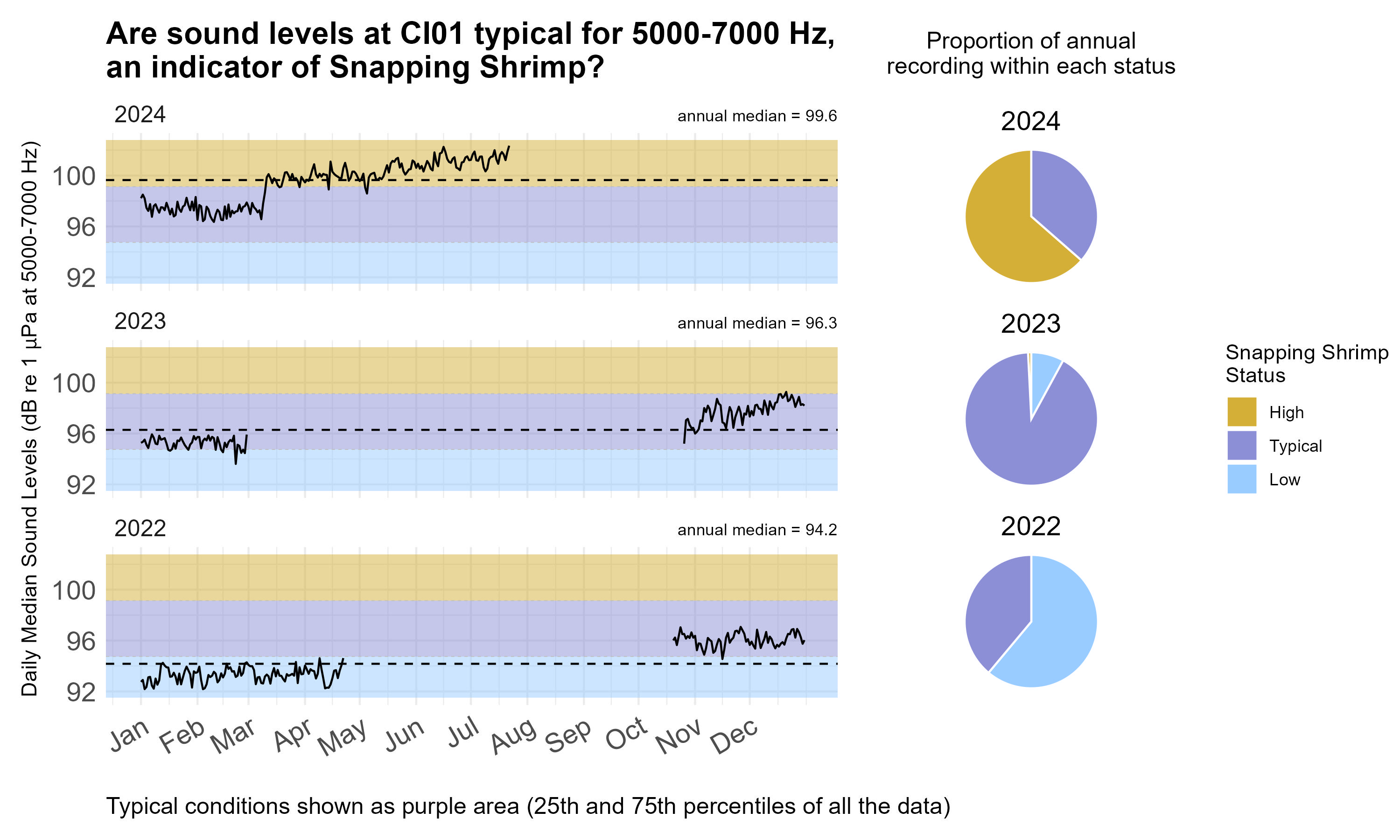
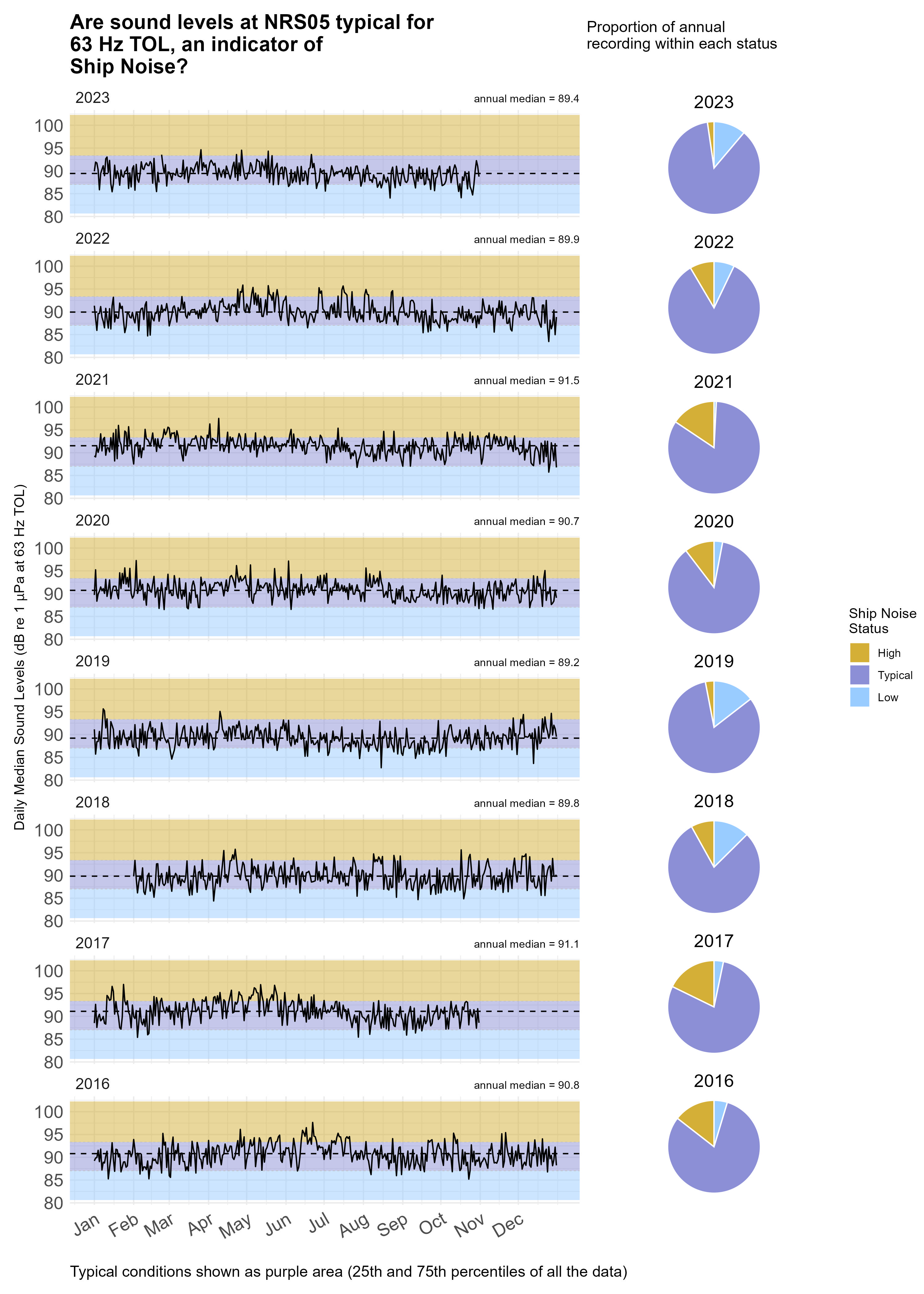
Time series plot of daily median sound levels (sound intensity measured by mean-square pressure in microPascal per Hertz) for a specific frequency band(s) of interest at this site, separated by year. Background color shading (blue, purple, gold) indicates low (<25th percentile), typical (25-75th percentile), and high sound levels (>75th percentile) across the entire dataset at this frequency band(s) for comparability with annual medians, marked with horizontal black dashed lines. Pie charts on the right hand side of the graphic show the proportion of daily median sound levels that fell within each category for each year, following the same color-coding and percentile bins.


Time series plot of daily median sound levels (sound intensity measured by mean-square pressure in microPascal per Hertz) for a specific frequency band(s) of interest at this site, separated by year. Background color shading (blue, purple, gold) indicates low (<25th percentile), typical (25-75th percentile), and high sound levels (>75th percentile) across the entire dataset at this frequency band(s) for comparability with annual medians, marked with horizontal black dashed lines. Pie charts on the right hand side of the graphic show the proportion of daily median sound levels that fell within each category for each year, following the same color-coding and percentile bins.


Time series plot of daily median sound levels (sound intensity measured by mean-square pressure in microPascal per Hertz) for a specific frequency band(s) of interest at this site, separated by year. Background color shading (blue, purple, gold) indicates low (<25th percentile), typical (25-75th percentile), and high sound levels (>75th percentile) across the entire dataset at this frequency band(s) for comparability with annual medians, marked with horizontal black dashed lines. Pie charts on the right hand side of the graphic show the proportion of daily median sound levels that fell within each category for each year, following the same color-coding and percentile bins.
Time series plot of daily median sound levels (sound intensity measured by mean-square pressure in microPascal per Hertz) for a specific frequency band(s) of interest at this site, separated by year. Background color shading (blue, purple, gold) indicates low (<25th percentile), typical (25-75th percentile), and high sound levels (>75th percentile) across this monitoring site's entire dataset at this frequency band(s) for comparability with annual medians, marked with horizontal black dashed lines. Pie charts on the right hand side of the graphic show the proportion of daily median sound levels that fell within each category for each year, following the same color-coding and percentile bins. Credit: Megan McKenna and Emma Beretta/CIRES and NOAA

Ocean Sound Indicators

We can use long-term monitoring of ocean sound to derive and track indicators of ocean conditions. These indicators track the status and trend of habitat condition, species presence, human-use patterns, and management activities. There are many analytical methods used to generate ocean sound indicators. Below are ocean sound indicators relevant to the sanctuary and available for condition tracking.

When does fish chorusing contribute to the soundscape?

Knowing when fish are calling helps identify important biological periods for fish species. A reduction in noise during these periods benefits fish communication. Use the graphics below to identify months of the year and times of the day with higher levels of fish chorus. For a more details on the analysis check out: Spatiotemporal patterns of fish chorusing in California National Marine Sanctuaries.

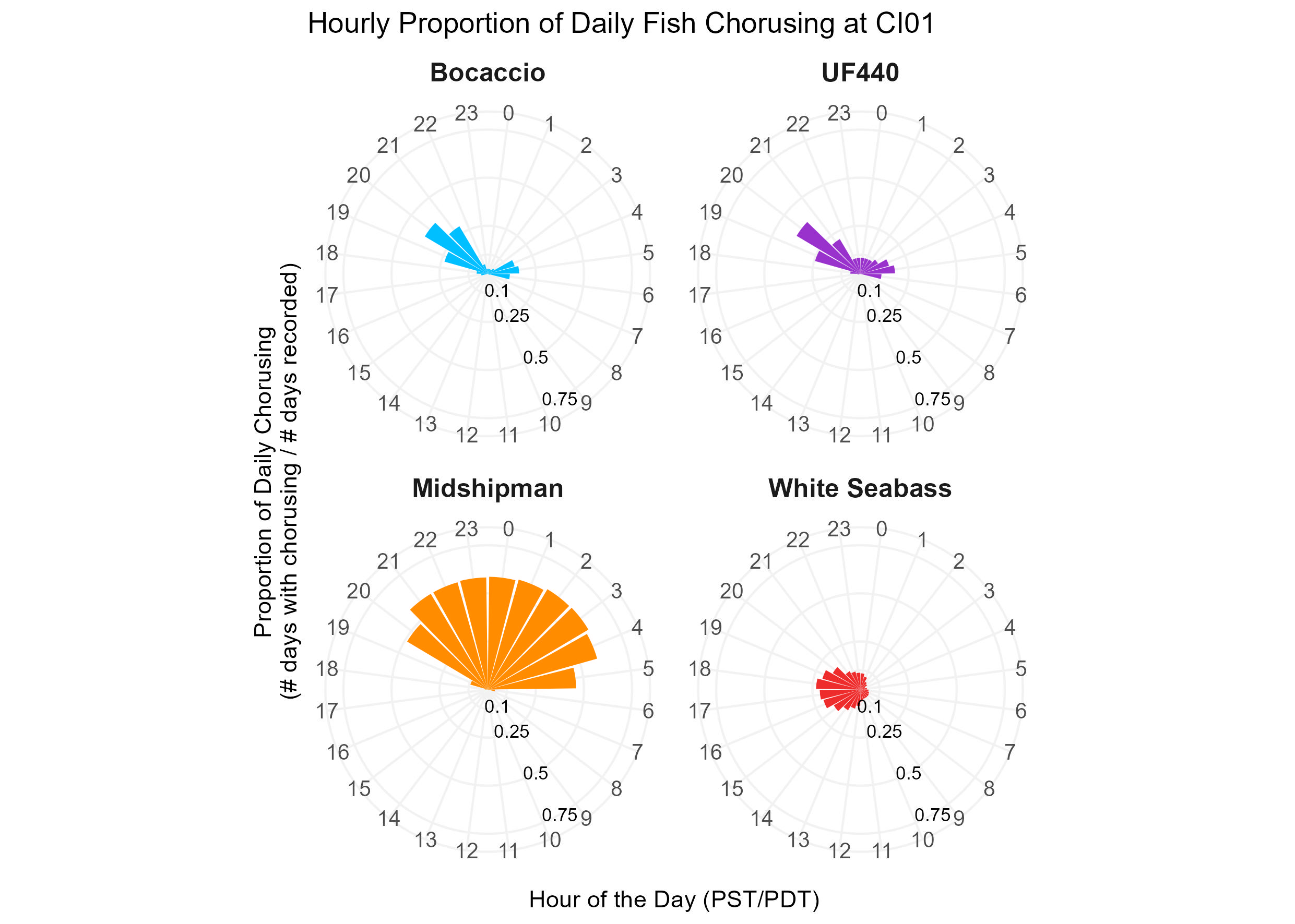
Rose plots (24 hour clock) of hourly proportion of fish chorusing detected for five fish species in the Channel Islands National Marine Sanctuary.
Radial plots showing the proportion of sampled acoustic data containing detections of fish chorusing, summarized by hour of day, for bocaccio (Sebastes paucispinis), plainfin midshipman (Porichthys notatus), white seabass (Atractoscion nobilis), and unknown fish species UF310 at listening stations CI01 and CI04 in the Channel Islands National Marine Sanctuary. Recording at CI01 spanned from November 2018 to September 2021 and CI04 recording spanned from November 2018 to November 2021. Daily chorusing activity for each fish species is the number of days with chorusing presence per number of days recorded. Credit: Emma Beretta/CIRES and NOAA

When are the seasonal biologically-important times for whales?

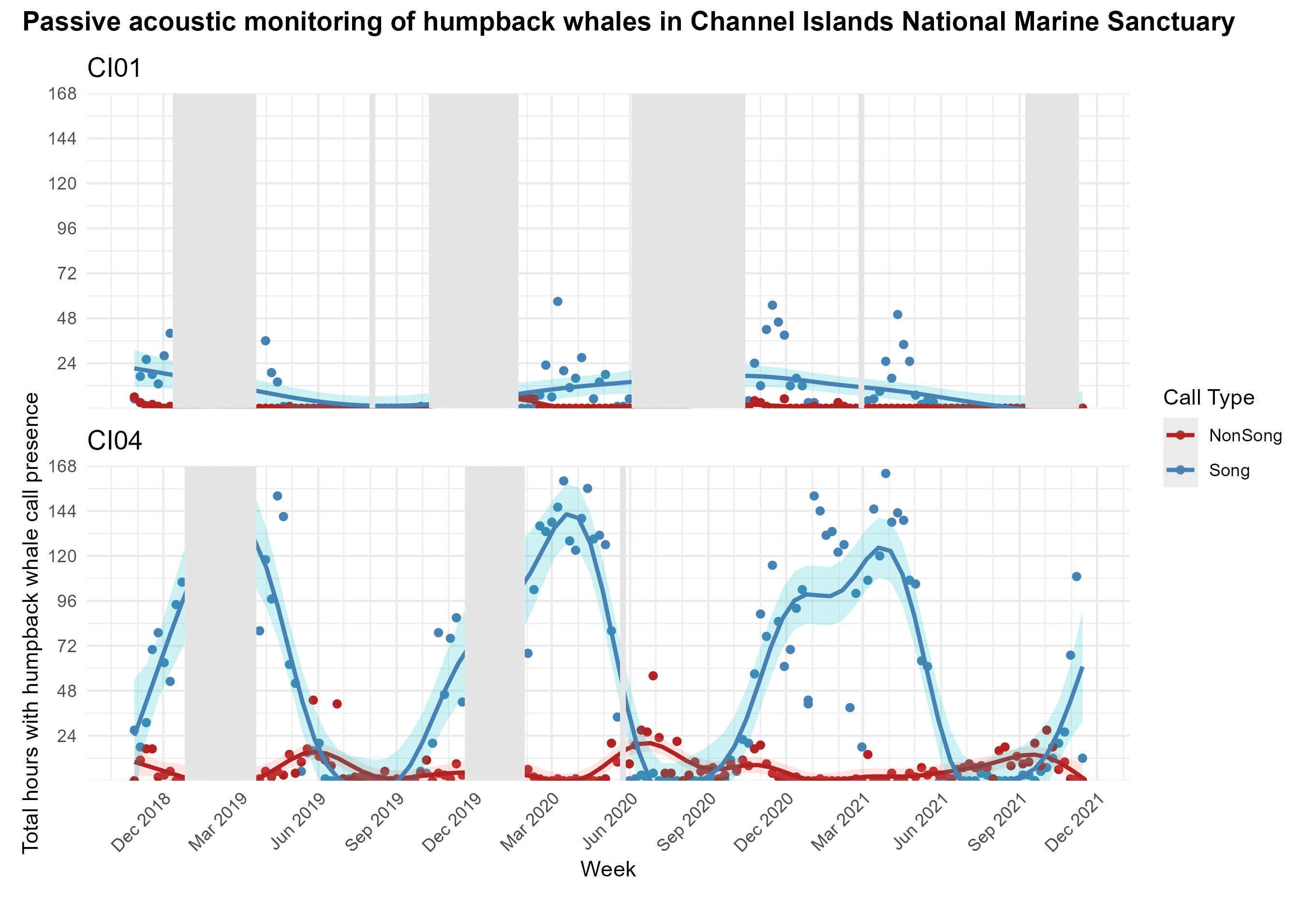
The Office of National Marine Sanctuaries (ONMS) maintains two CINMS listening stations with the Naval Postgraduate School, CI01 and CI04. We partnered with Moss Landing Marine Laboratories and Stanford Hopkins Marine Station to analyze data from this site for humpback whale vocalization, both song and non-song calls, to understand seasonality and potential behavior associated with calls over time. Visit Acoustic Presence of Humpback Whales in U.S. West Coast National Marine Sanctuaries and Unraveling Mysteries of Humpback Whale Song for more information.

Scatter plot with GAM model curves of weekly count of humpback whale acoustic presence for song and non song calls in the Channel Islands National Marine Sanctuary. Non-song calls peak during summer whereas song calls peak fall through spring with many more song calls than non-song calls.
The total number of humpback whale (Megaptera novaeangliae) song (blue dots) or non-song vocalizations (red dots) detected during a given week from November 2018 to November 2021 at two listening stations CI01 and CI04 in the Channel Islands National Marine Sanctuary. Shaded grey regions indicate weeks with reduced recording effort (less than 75% of the week, or <126 recording hours). The smoothed blue curve highlights seasonal patterns in whale calling activity, modeled using a generalized additive model (GAM), and the shaded band surrounding it represents the model-estimated 95% confidence interval. Credit: Emma Beretta/CIRES and NOAA