Ocean sound is critical for the survival of many marine animals because it is a primary means of communication, orientation and navigation, finding food, avoiding predators, and choosing mates. Many of the things people do offshore also introduce sound underwater. Therefore, we can use sound to track how people are using offshore spaces, just as we track marine animals. We can also track how human activities that produce underwater sounds interfere with animals' ability to hear prey, predators, and each other. U.S. marine environments are home to a wide variety of marine animals that rely on sound, making it a conservation priority to understand where these animals occur and how human-generated noise affects them.
U.S. Ocean Sound Monitoring and Condition Reporting
Why are we monitoring ocean sound?
Overview of NOAA ocean sound monitoring effort
NOAA sound monitoring programs provide important information about species presence, soundscape conditions, and long-term trends. NOAA's Office of National Marine Sanctuaries (ONMS) maintains a nationally coordinated underwater sound monitoring network across the National Marine Sanctuary System, known as ONMS Sound. ONMS Sound works with partners to monitor ONMS regions: Eastern, West Coast, and Pacific Islands. ONMS Sound monitoring sites record in strategic locations within sanctuary boundaries and prioritize maintaining previously established monitoring sites for understanding long-term trends. The NOAA Noise Reference Station (NRS) Network is a collaboration between NOAA’s National Marine Fisheries Service (NMFS or NOAA Fisheries), ONMS, Pacific Marine Environmental Laboratory, and the National Park Service to collect consistent and comparable long-term low-frequency acoustic data sets covering all major regions of U.S. deep waters. NOAA Fisheries uses passive acoustic monitoring tools to study marine mammals, fishes, environmental, and anthropogenic sounds, and to summarize important information for conservation, including changes in species distribution, behavior and/or density. Recordings and standardized sound measurements for ONMS Sound, NRS and NOAA Fisheries datasets are available through the NOAA National Centers for Environmental Information's (NCEI) Passive Acoustic Data Archive. These monitoring programs, along with many others, are actively collaborating with NCEI to increase the amount of PAM recordings available in the federal archive. Explore open access ocean sound monitoring data through the NCEI Passive Acoustic Data Map Viewer below. You can filter by 'Monitoring Programs' (e.g., “ONMS”, “NRS” or “NMFS”) using the drop down on the left panel, which you can expand by clicking the arrow on the left. You can also add additional map layers like sanctuary boundaries using the 'Layer list' tab and selecting 'NOAA Marine Protected Areas Inventory 2024 - Federal MPAs'.
Underwater sound data available through NCEI Passive Acoustic Data Archive, summarized in these reports
Open access data summarized below are available through the NCEI Google Cloud Platform. Projects are represented by the different color bars. The NOAA Sanctuary Soundscape Monitoring Project (or "SanctSound") collected data from 2018-2022. Some sites continued beyond 2022 to become long-term monitoring sites for ONMS Sound. NOAA Noise Reference Station (NRS) data collection began in 2014. Scripps Institution of Oceanography Marine Bioacoustics Research Collaborative (MBARC) has collected data across the West Coast for many years.
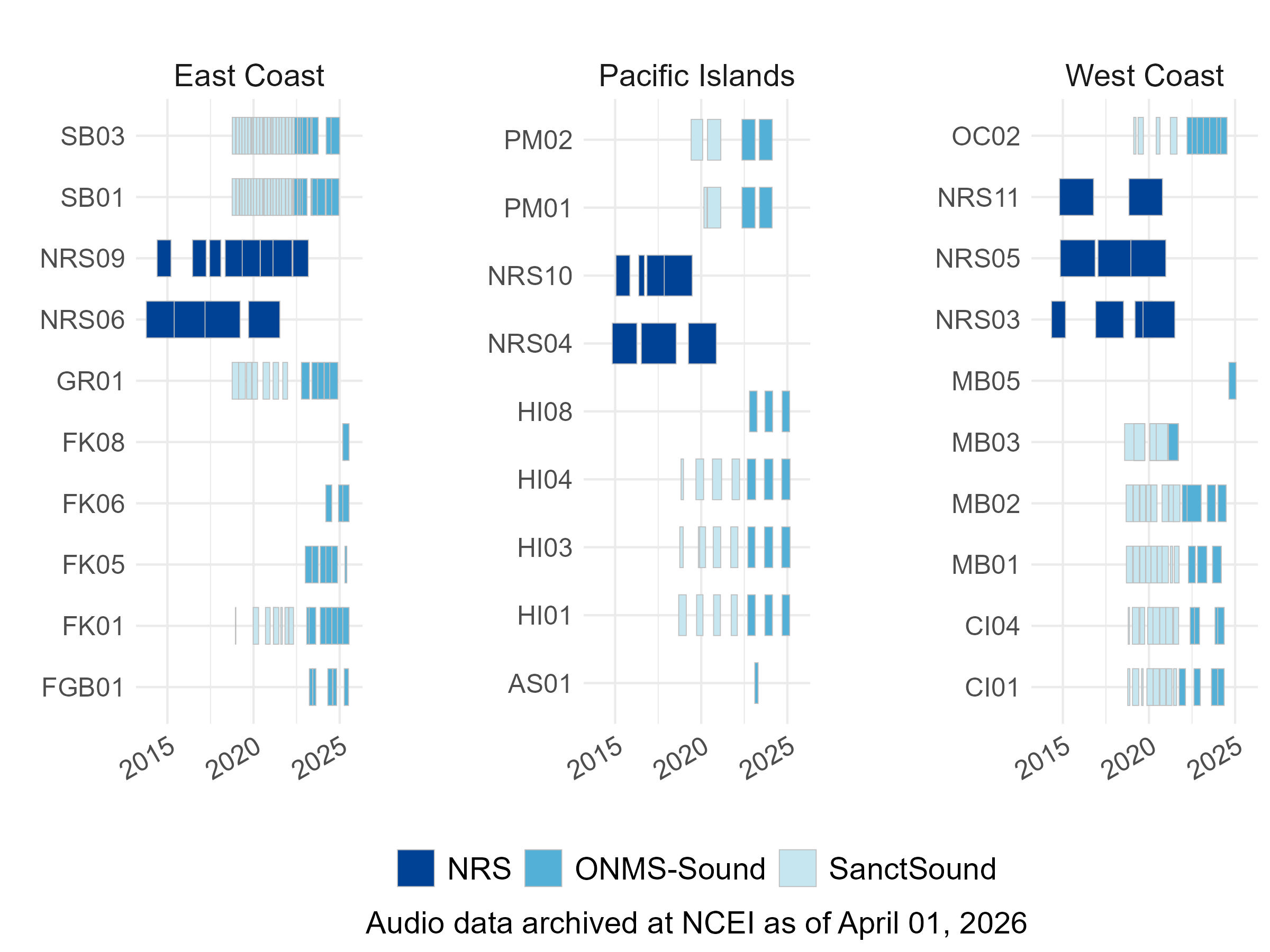
Time periods of U.S. ocean sound data archived at NOAA’s NCEI and included in this report (2014–present), organized by monitoring site and color-coded by project. Credit: Megan McKenna and Emma Beretta/CIRES and NOAA
Understanding ocean sound
Soundscapes reflect the unique combination of sounds present at a given location and time, influenced by sources such as marine animals, human activities, and weather. Standardized soundscape metrics allow us to track changes over time and compare conditions across locations. We can also use ocean sound data as indicators for specific sound sources, such as whales and vessels, in a soundscape.
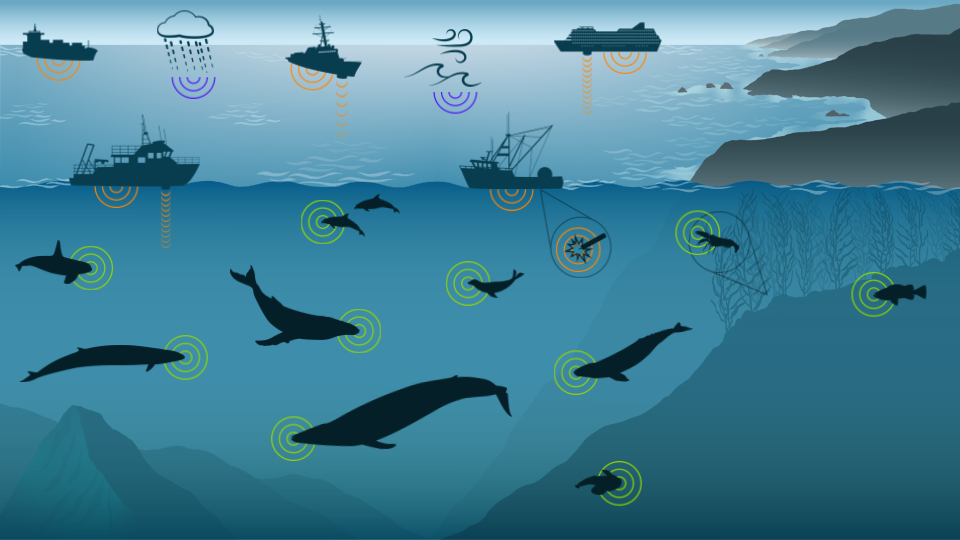
Infographic of icons representing examples of different sound sources in the ocean. Image: Aline Design for NOAA
Sound can be described in a variety of different ways. Two key attributes of sound are intensity or "loudness" and frequency or "pitch". Other attributes describe how the sound occurred over time: was it a short burst or a long-lasting hum? Standard measurements of “sound levels” summarize all of these attributes: intensity, frequency, and duration.
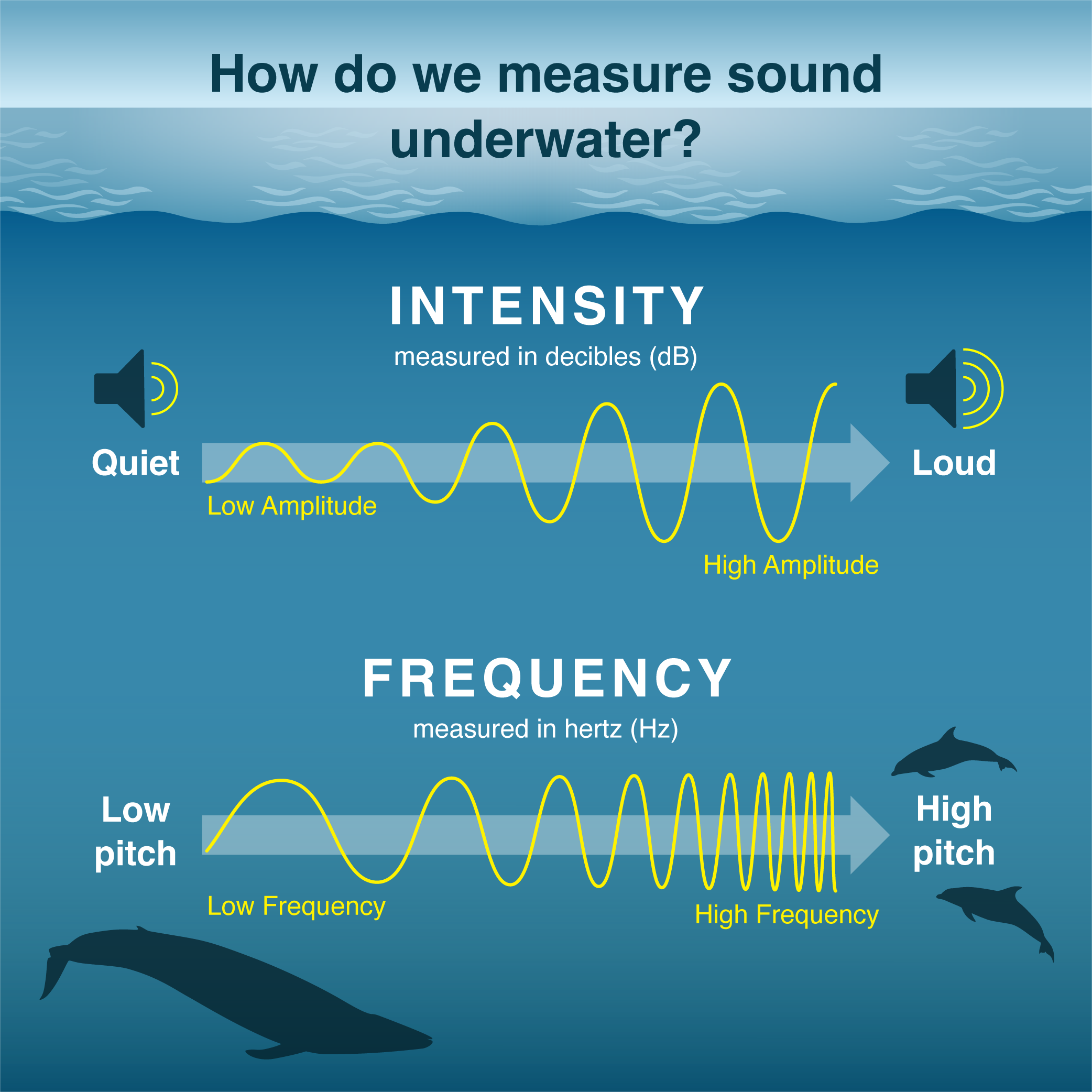
Intensity or “loudness” is measured in decibels and describes how much pressure the sound contains (the amplitude); a low decibel or quiet sound contains less amplitude than a high decibel or loud sound. Frequency or "pitch" is measured in hertz and provides information about tones that are contained in a sound. Image: Aline Design for NOAA
Sounds can be visualized using a spectrogram. A spectrogram shows how the frequency, intensity, and timing of sounds change over time.
- Frequency (pitch) is shown on the vertical axis. Lower-frequency, deeper sounds appear toward the bottom of the spectrogram, while higher-frequency, higher-pitched sounds appear toward the top.
- Time moves from left to right along the horizontal axis, allowing you to see how a sound changes and the duration over time.
- Color represents the intensity of the sound. Darker blue colors indicate quieter sounds, while colors progressing toward yellow indicate more intense or louder sounds. Sound intensity is measured in decibels relative to 1 micropascal squared per hertz (dB re 1 μPa²/Hz).
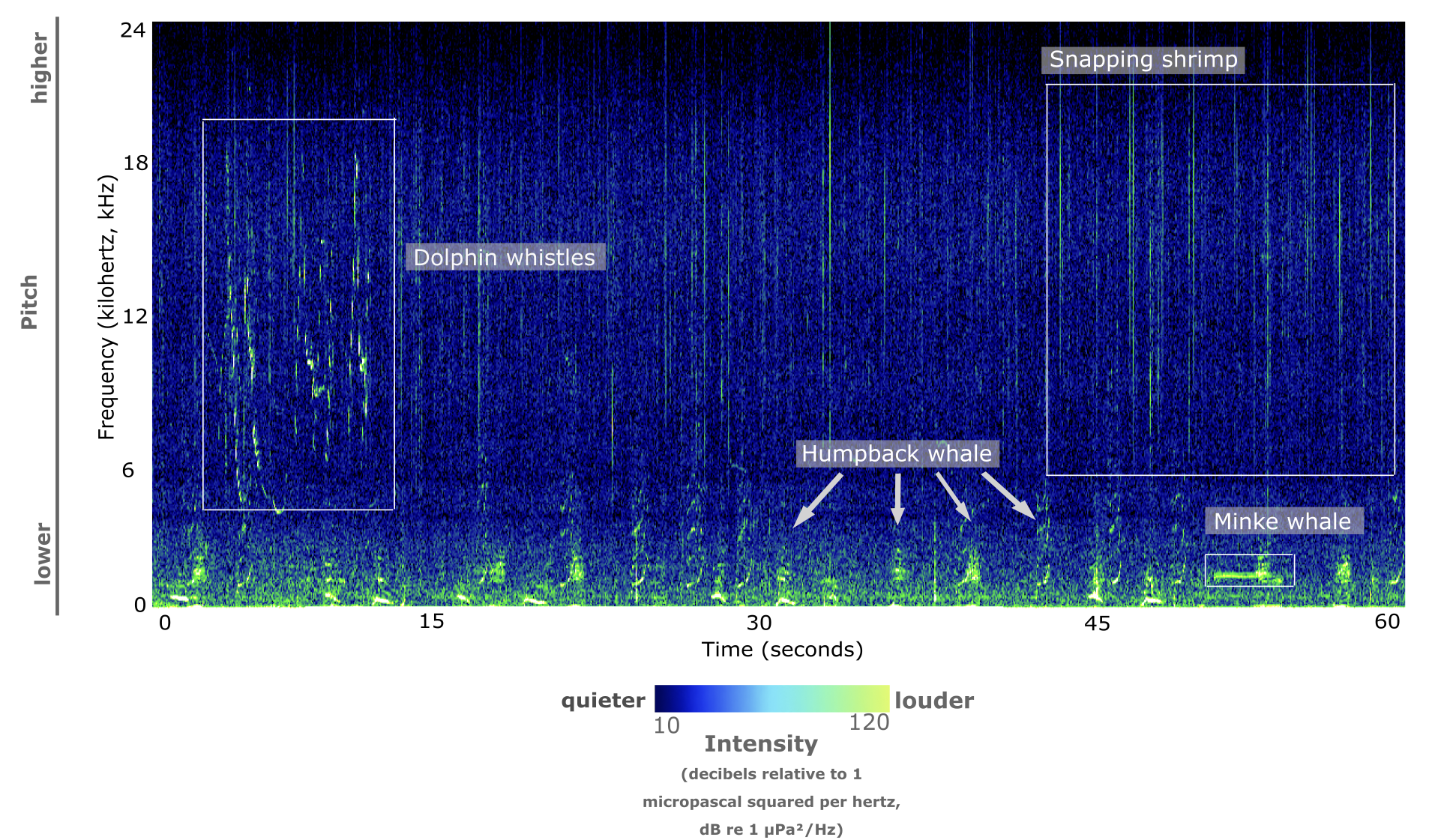
Spectrogram showing unique calls by species including dolphins, humpback whales, snapping shrimp and minke whale. Credit: Hadley Clark/CMSF and NOAA
Ocean Sound Conditions
Soundscapes vary across years, seasons, and even within a day. These differences are driven by shifts in wind and weather patterns, migration and behavior of animals, and patterns in human activities. To compare differences and summarize patterns across seasons and years, we track how sound levels change across frequencies using standardized soundscape metrics at each monitoring location.
The example graphic below shows how we visualize soundscape conditions for four seasonal categories (winter, spring, summer, and fall). Here, sound is measured in terms of frequency on the x-axis and intensity on the y-axis. The colored lines represent seasonal categories; vertical dashed lines and grey shaded areas show the frequency range where a sound source of interest can be heard, and the black lines bound the soundscape to expected range of intensity based on when only wind noise is present in that location.
The example graphic below shows how we visualize soundscape conditions for four seasonal categories (winter, spring, summer, and fall). Here, sound is measured in terms of frequency on the x-axis and intensity on the y-axis. The colored lines represent seasonal categories; vertical dashed lines and grey shaded areas show the frequency range where a sound source of interest can be heard, and the black lines bound the soundscape to expected range of intensity based on when only wind noise is present in that location.
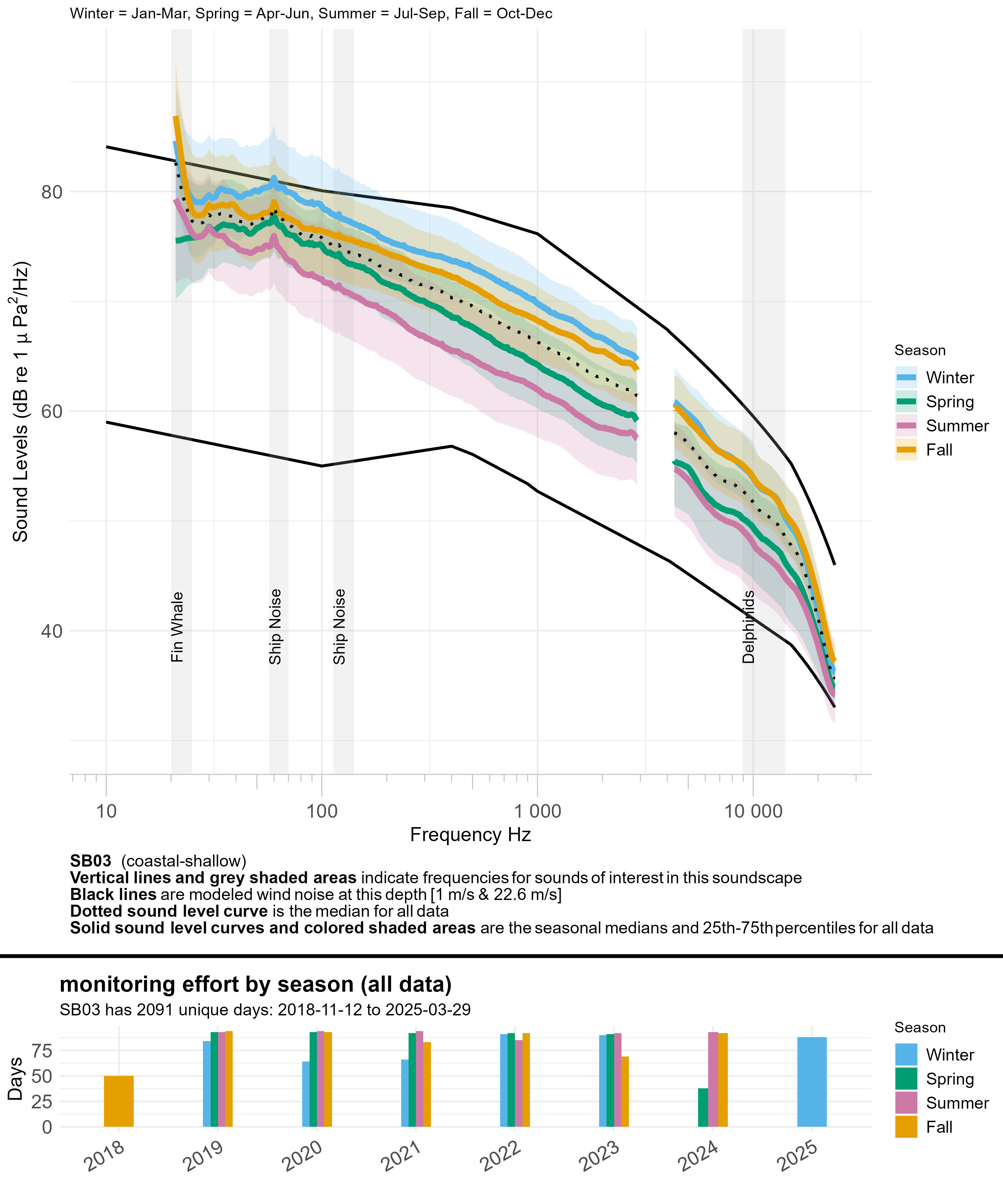
Seasonal median sound levels (measured by mean-square pressure in micropascal squared per Hz) across a range of frequencies (~10 to ~24,000 Hz) at a given monitoring site, with annual recording effort represented by a bar graph underneath. Each season is a different colored line. Solid black lines show modeled ambient sound levels from wind at 1 m/s (lower line) and 22.6 m/s (upper line) based on hydrophone depth. Frequency bands indicative of a biological or anthropogenic sound source of interest are highlighted in semi-transparent gray and labeled; peak frequency for dominant fish species are labeled with vertical dashed lines. Credit: Megan McKenna and Emma Beretta/CIRES and NOAA
Ocean Sound Indicators
Ocean sound indicators are resource management-relevant metrics derived from long-term monitoring of ocean sound. These indicators track the status and trend of habitat condition, species presence, human-use patterns, and management activities. There are many analytical methods used to generate ocean sound indicators. In some locations sound frequencies are dominated by a specific source and we can use this frequency (e.g. 125 Hz for vessel noise) to track conditions. Other methods detect specific sources of interest. For example, NOAA Fisheries has developed a portal to explore the presence of marine mammalas detected from ocean sound monitoring data. Detecting fish sounds is another priority for ONMS. The graphic below is an example of how ocean sound data are used to identify when fish produce sounds, an indicator of biologically important times.
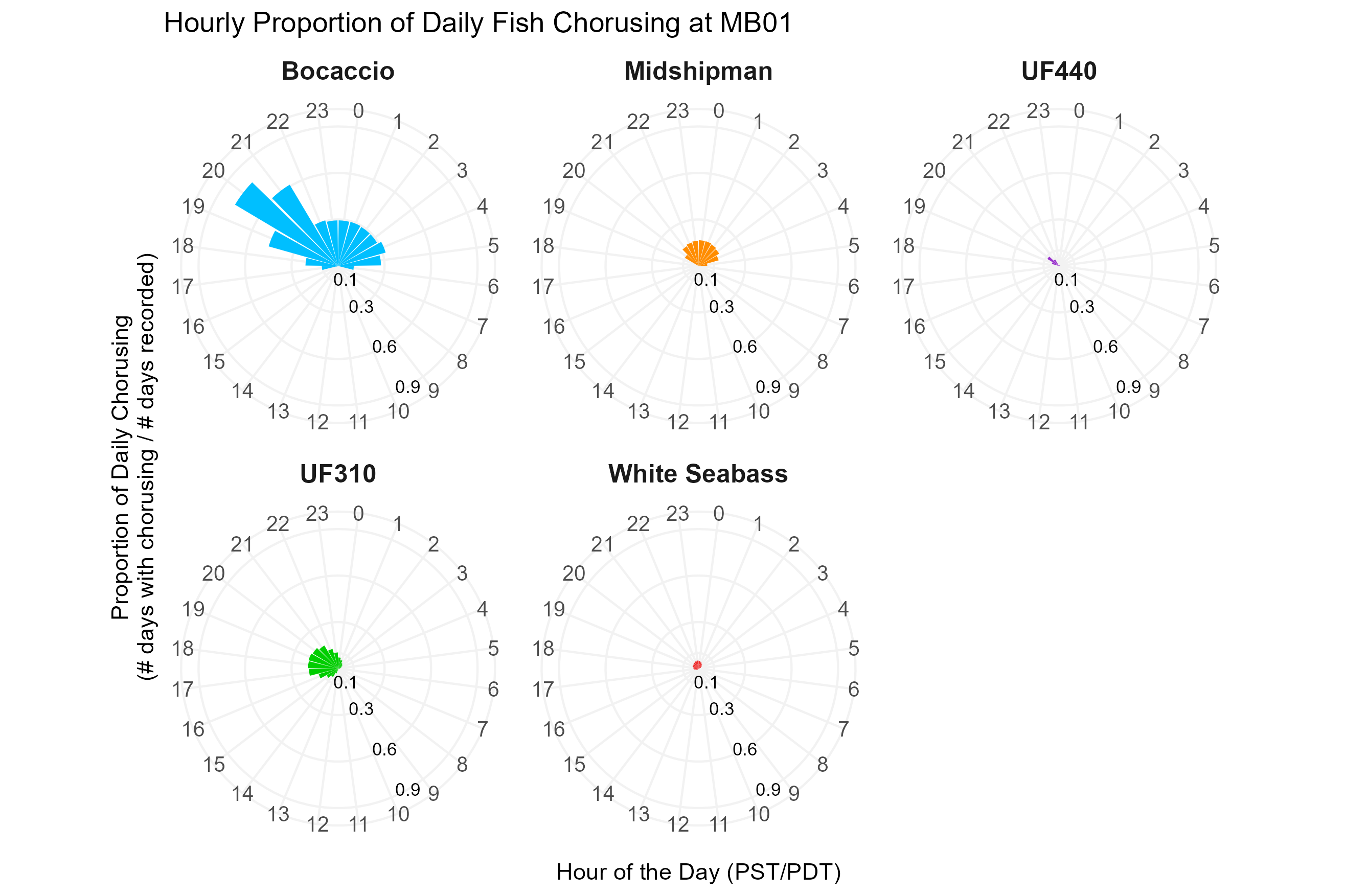
Radial plots showing the proportion of sampled acoustic data containing detections of fish chorusing, summarized by hour of day, for bocaccio (Sebastes paucispinis), plainfin midshipman (Porichthys notatus), white seabass (Atractoscion nobilis), and two unknown fish species UF440 and UF310 at listening stations MB01 in Monterey Bay National Marine Sanctuary. Recording at MB01 spanned from November 2018 to August 2023. Daily chorusing activity for each fish species is the number of days with chorusing presence per number of days recorded. Credit: Emma Beretta/CIRES and NOAA
Frequent reporting on NOAA sound data from ONMS and NRS long-term monitoring sites helps to ensure the most recent information is available for sanctuaries. These updated web-based reports include the most recent results on ocean sound conditions. The reports aim to provide:
(1) a summary of available ocean sound monitoring data for NOAA researchers and partners to review and evaluate seasonal and annual conditions;
(2) a communication tool that synthesizes hundreds of terabytes of ocean sound data into information about the status and trends of ocean sound conditions and indicators relevant to each sanctuary and region;
(3) an overview of ocean sound indicators that are available for sanctuary condition tracking in Sanctuary Watch.
To explore results for a specific sanctuary, click on the sanctuary name shown on the left panel of this page.
What are we learning?
Collaborative partnerships help us gain key insights on sanctuary resources and conditions from ocean sound data by leveraging ecological and technological expertise. Here are a few recent examples:
Kok, A. C. M., Soderstjerna, C., Kim, E. B., Joseph, J. E., Margolina, T., Peavey Reeves, L. E., Hatch, L. T., & Baumann-Pickering, S. (2026). Acoustic behavior and diversity of fish calling in the Channel Islands. Journal of the Acoustical Society of America Express Letters, 6(1), 011202.
Hatch, L., McKenna, M., Burnham, R., Frasier, K., Gabriele, C., Hastings, S., Haver, S., Kunz, A., MacGillivray, A., Malinka, C., Morten, J., Peavey Reeves, L., Trounce, K., Vagle, S., Wood, J., & ZoBell, V. (2025). A call for comparable measurements of underwater radiated noise related to vessel speed reduction programs. Journal of the Acoustical Society of America Express Letters, 5(8), 087201.
ZoBell, V. M., Posdaljian, N., Lenssen, K. L., Wiggins, S. M., Hildebrand, J. A., Baumann-Pickering, S., & Frasier, K. E. (2025). Climatic and economic fluctuations revealed by decadal ocean soundscapes. Journal of the Acoustical Society of America, 157(6), 4233–4251.
Ryan, J. P., Oestreich, W. K., Benoit-Bird, K. J., Waluk, C. M., Rueda, C. A., Cline, D. E., & others. (2025). Audible changes in marine trophic ecology: Baleen whale song tracks foraging conditions in the eastern North Pacific. PLoS ONE, 20(2), e0318624
Haver, S. M., Dziak, R. P., Hatch, L. T., Haxel, J., Kavanagh, C., Matsumoto, H., McKenna, M. F., Roche, L., Van Parijs, S. M., Wall, C. C., & Gedamke, J. (2025). Retrospective on decadal progress of the NOAA/NPS ocean noise reference station network. PeerJ, 13, e20382.
Kim, E., Kok, A., Beretta, E., Donahue, E., Hatch, L., Joseph, J., Margolina, T., Oestreich, W., Peavey Reeves, L., Ryan, J., Zobell, V. M., & Baumann-Pickering, S. (2025). Fish chorusing patterns in California (USA) National Marine Sanctuaries. Fish chorusing patterns in California (USA) National Marine Sanctuaries. Marine Ecology Progress Series, 764, 135-159.
McKenna, M. F., Rowell, T. J., Margolina, T., Baumann-Pickering, S., Solsona-Berga, A., Adams, J. D., ... & Hatch, L. T. (2024). Understanding vessel noise across a network of marine protected areas. Environmental Monitoring and Assessment, 196(4), 369.
Zang, E., Lammers, M., Pack, A., and Hatch, L. (2024). Impulsive sounds produced by humpback whale surface active behavior recorded on acoustic tags and bottom‐moored recorders. Marine Mammal Science, 40(1), 302-308.
Madrigal, B. C., Kügler, A., Zang, E., Lammers, M., Hatch, L. T., and Pacini, A. F. (2024). Comparing the underwater soundscape of the Hawaiian Islands Humpback Whale National Marine Sanctuary and potential influences of the COVID-19 pandemic. Frontiers in Marine Science, 11, 1342454.
Kim, E. B., Frasier, K. E., McKenna, M. F., Kok, A., Peavey Reeves, L. E., Oestreich, W. K., ... & Baumann-Pickering, S. (2023). Soundscape learning: An automatic method for separating fish chorus in marine soundscapes. The Journal of the Acoustical Society of America, 153(3), 1710-1722.
Lammers, M.O., Goodwin B., Kügler, A., Zang, E.J., Harvey, M., Margolina, T., Martinez, J.A., Merkens, K. and Hatch, L.T. (2023). The occurrence of humpback whales across the Hawaiian archipelago revealed by fixed and mobile acoustic monitoring . Frontiers in Marine Science, 10:1083583.
DeAngelis, A. I., Van Parijs, S. M., Barkowski, J., Baumann-Pickering, S., Burger, K., Davis, G. E., ... & Hatch, L. (2022). Exploring marine mammal presence across seven US national marine sanctuaries. Frontiers in Remote Sensing, 3, 970401.
McKenna, M. F., Baumann-Pickering, S., Kok, A. C., Oestreich, W. K., Adams, J. D., Barkowski, J., ... & Hatch, L. T. (2021). Advancing the interpretation of shallow water marine soundscapes. Frontiers in Marine Science, 8, 719258.
Ryan, J. P., Joseph, J. E., Margolina, T., Hatch, L. T., Azzara, A., Reyes, A., Southall, B. L., DeVogelaere, A., Peavey Reeves, L. E., Zhang, Y., Cline, D. E., Jones, B., McGill, P., Baumann-Pickering, S., & Stimpert, A. K. (2021). Reduction of low-frequency vessel noise in Monterey Bay National Marine Sanctuary during the COVID-19 pandemic. Frontiers in Marine Science, 8, 656566.
Learn more about the diversity of ocean sounds at Discovery of Sound in the Sea.
You can also learn more about earlier datasets from the Sanctuary Soundscape Monitoring Project (or "SanctSound"), which collected data from 2018-2022.
Kok, A. C. M., Soderstjerna, C., Kim, E. B., Joseph, J. E., Margolina, T., Peavey Reeves, L. E., Hatch, L. T., & Baumann-Pickering, S. (2026). Acoustic behavior and diversity of fish calling in the Channel Islands. Journal of the Acoustical Society of America Express Letters, 6(1), 011202.
Hatch, L., McKenna, M., Burnham, R., Frasier, K., Gabriele, C., Hastings, S., Haver, S., Kunz, A., MacGillivray, A., Malinka, C., Morten, J., Peavey Reeves, L., Trounce, K., Vagle, S., Wood, J., & ZoBell, V. (2025). A call for comparable measurements of underwater radiated noise related to vessel speed reduction programs. Journal of the Acoustical Society of America Express Letters, 5(8), 087201.
ZoBell, V. M., Posdaljian, N., Lenssen, K. L., Wiggins, S. M., Hildebrand, J. A., Baumann-Pickering, S., & Frasier, K. E. (2025). Climatic and economic fluctuations revealed by decadal ocean soundscapes. Journal of the Acoustical Society of America, 157(6), 4233–4251.
Ryan, J. P., Oestreich, W. K., Benoit-Bird, K. J., Waluk, C. M., Rueda, C. A., Cline, D. E., & others. (2025). Audible changes in marine trophic ecology: Baleen whale song tracks foraging conditions in the eastern North Pacific. PLoS ONE, 20(2), e0318624
Haver, S. M., Dziak, R. P., Hatch, L. T., Haxel, J., Kavanagh, C., Matsumoto, H., McKenna, M. F., Roche, L., Van Parijs, S. M., Wall, C. C., & Gedamke, J. (2025). Retrospective on decadal progress of the NOAA/NPS ocean noise reference station network. PeerJ, 13, e20382.
Kim, E., Kok, A., Beretta, E., Donahue, E., Hatch, L., Joseph, J., Margolina, T., Oestreich, W., Peavey Reeves, L., Ryan, J., Zobell, V. M., & Baumann-Pickering, S. (2025). Fish chorusing patterns in California (USA) National Marine Sanctuaries. Fish chorusing patterns in California (USA) National Marine Sanctuaries. Marine Ecology Progress Series, 764, 135-159.
McKenna, M. F., Rowell, T. J., Margolina, T., Baumann-Pickering, S., Solsona-Berga, A., Adams, J. D., ... & Hatch, L. T. (2024). Understanding vessel noise across a network of marine protected areas. Environmental Monitoring and Assessment, 196(4), 369.
Zang, E., Lammers, M., Pack, A., and Hatch, L. (2024). Impulsive sounds produced by humpback whale surface active behavior recorded on acoustic tags and bottom‐moored recorders. Marine Mammal Science, 40(1), 302-308.
Madrigal, B. C., Kügler, A., Zang, E., Lammers, M., Hatch, L. T., and Pacini, A. F. (2024). Comparing the underwater soundscape of the Hawaiian Islands Humpback Whale National Marine Sanctuary and potential influences of the COVID-19 pandemic. Frontiers in Marine Science, 11, 1342454.
Kim, E. B., Frasier, K. E., McKenna, M. F., Kok, A., Peavey Reeves, L. E., Oestreich, W. K., ... & Baumann-Pickering, S. (2023). Soundscape learning: An automatic method for separating fish chorus in marine soundscapes. The Journal of the Acoustical Society of America, 153(3), 1710-1722.
Lammers, M.O., Goodwin B., Kügler, A., Zang, E.J., Harvey, M., Margolina, T., Martinez, J.A., Merkens, K. and Hatch, L.T. (2023). The occurrence of humpback whales across the Hawaiian archipelago revealed by fixed and mobile acoustic monitoring . Frontiers in Marine Science, 10:1083583.
DeAngelis, A. I., Van Parijs, S. M., Barkowski, J., Baumann-Pickering, S., Burger, K., Davis, G. E., ... & Hatch, L. (2022). Exploring marine mammal presence across seven US national marine sanctuaries. Frontiers in Remote Sensing, 3, 970401.
McKenna, M. F., Baumann-Pickering, S., Kok, A. C., Oestreich, W. K., Adams, J. D., Barkowski, J., ... & Hatch, L. T. (2021). Advancing the interpretation of shallow water marine soundscapes. Frontiers in Marine Science, 8, 719258.
Ryan, J. P., Joseph, J. E., Margolina, T., Hatch, L. T., Azzara, A., Reyes, A., Southall, B. L., DeVogelaere, A., Peavey Reeves, L. E., Zhang, Y., Cline, D. E., Jones, B., McGill, P., Baumann-Pickering, S., & Stimpert, A. K. (2021). Reduction of low-frequency vessel noise in Monterey Bay National Marine Sanctuary during the COVID-19 pandemic. Frontiers in Marine Science, 8, 656566.
Learn more about the diversity of ocean sounds at Discovery of Sound in the Sea.
You can also learn more about earlier datasets from the Sanctuary Soundscape Monitoring Project (or "SanctSound"), which collected data from 2018-2022.